Choosing between PCB fabrication methods feels complicated. You worry that picking the wrong one will blow your budget. But the answer is really a simple business decision.
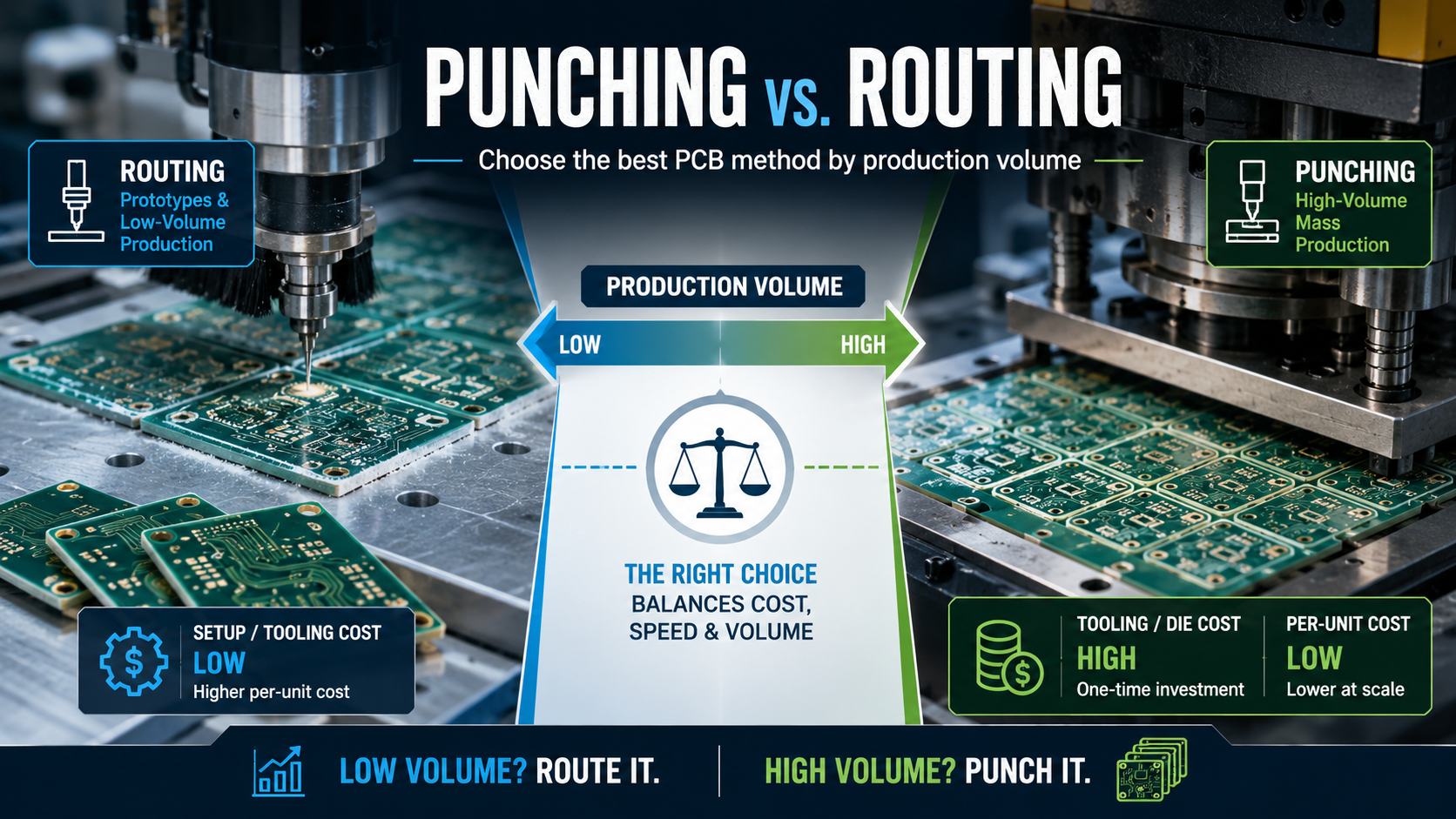
The best method depends on your production volume. PCB routing is cost-effective for prototypes and low-volume runs due to zero tooling costs.1 PCB punching is better for mass production, where the high initial mold cost is quickly offset by a very low per-unit cost.2
I've helped hundreds of clients navigate this exact choice. Many product managers and engineers come to us thinking it’s a highly technical debate. They are surprised when I tell them it's almost always a commercial decision. The technical differences matter, but they usually point back to the same two factors: cost and volume. A good manufacturing partner helps you figure out the math for your specific project. Let's walk through how we do that.
How Does Production Volume Change the Cost Equation?
You see a high tooling fee for punching but a very low per-unit price. It's confusing to know which is cheaper overall. But there's a simple way to find your break-even point.
You can calculate your break-even point by dividing the one-time mold cost by the per-unit savings you get with punching versus routing.3 If your total production volume is higher than that number, punching saves you money.
When a client asks me for a quote, the first question I ask is, "What is your projected volume for this product's lifetime?" The answer tells me almost everything I need to know. The decision isn't about a single order; it's about the total cost over time. We've seen teams go over budget because they only looked at the per-unit price and ignored the tooling cost, or vice versa.
Let’s break down the total cost. You need three numbers from your supplier:
- The per-unit cost for routing.
- The per-unit cost for punching.
- The one-time cost for the punching mold (tooling).
Here is the simple math:
| Cost Calculation | Formula |
|---|---|
| Total Routing Cost | (Number of Units) x (Per-Unit Routing Cost) |
| Total Punching Cost | (Mold Cost) + (Number of Units) x (Per-Unit Punching Cost) |
Your break-even point is the volume where these two totals are equal. Any unit produced beyond that point is where your savings with punching begin. This simple calculation turns a confusing technical choice into a clear business decision.
Are There Design Limits I Should Worry About?
You've done the math and punching seems like the clear winner. But you worry your board might be too complex or fragile. Understanding the physical limits of each method is key.
Yes, design limits are a major factor. Routing offers high precision for complex shapes and is gentle on boards, which is crucial for sensitive components.4 Punching creates mechanical stress and is less precise, making it better for simple designs.5
Cost is the first filter, but design is the second. Punching is a powerful, high-speed shearing action. Think of using a cookie-cutter on dough. It’s fast and efficient for simple shapes, but it can deform the edges. This mechanical stress, or shock, can be a problem for certain designs. If you have delicate surface-mount components like ceramic capacitors or fine-pitch connectors very close to the board edge, the shock from punching could cause micro-cracks and lead to field failures.6
Routing, on the other hand, is like using a small milling tool. It's slower but much more precise and gentle.7 It can cut intricate contours, sharp internal corners, and complex shapes that are impossible with a punch.
Here is a simple comparison I often share with clients:
| Feature | PCB Routing | PCB Punching |
|---|---|---|
| Precision | Very High | Moderate |
| Edge Stress | Very Low | Can be High |
| Complex Shapes? | Yes, ideal for intricate outlines | Limited to simpler shapes and curves |
| Best For | Prototypes, low-volume, complex designs | High-volume, simple, robust designs |
| Tooling Cost | None | High |
If your design is simple, your material is standard (like FR-4), and you have enough clearance between components and the edge, punching is a great way to save money at high volumes. But for complex, dense, or fragile boards, routing is the safer choice, even if the per-unit cost is higher.
How Should I Discuss This with My Manufacturing Partner?
You feel pressured to choose a fabrication method you don't fully understand. Making the wrong call can lead to costly mistakes. A good partner will guide you by asking the right questions.
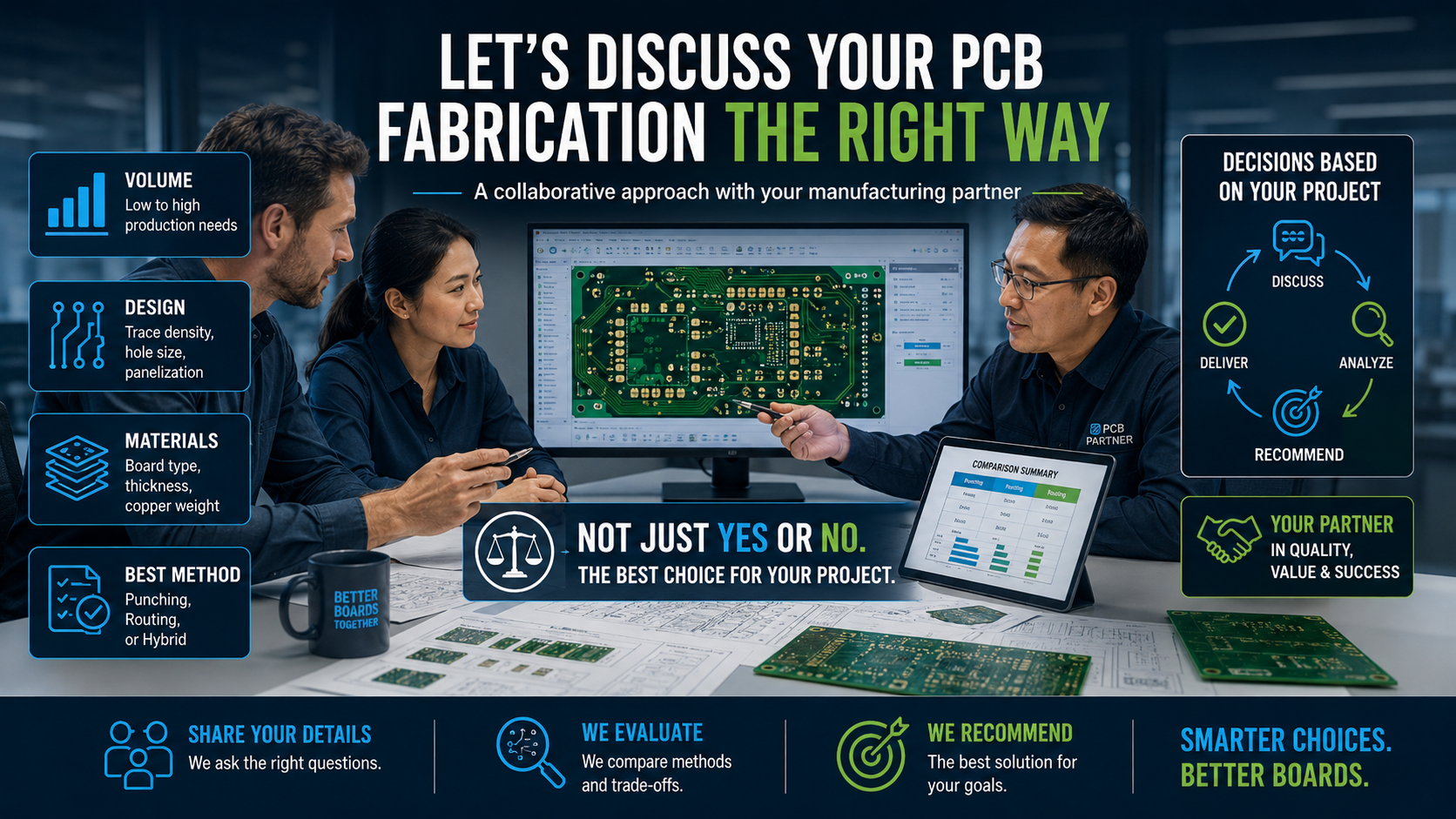
Don't start the conversation by asking for "punching or routing." Instead, share your project details. A good supplier will ask about your expected volume, design, and materials to recommend the best, most cost-effective solution for you.
A red flag for me is when a supplier just sends back a price list. A true manufacturing partner acts more like a consultant. Their goal is to build a long-term relationship, not just win a single order. They know that if they help you succeed, you'll bring them more business. So, they will start by asking questions to understand your project completely.
This is what a productive conversation looks like. You should be prepared to share:
- Projected Volume: Not just for this order, but for the next year or the product's lifetime.
- Batch Sizes: Do you plan to order 50,000 at once, or 5,000 per month for ten months?
- Your Design Files: A good partner will want to review your Gerber files to check for potential issues.
- Board Material: The material (e.g., FR-4, CEM-1, aluminum) and its thickness affect the choice.
- Critical Components: Point out any sensitive components, especially those near the board's edge.
When a partner asks these questions, they are not creating work for you. They are doing their job to prevent costly mistakes. They are using their experience to protect you from issues like board failure, budget overruns, and project delays. Their recommendation, based on this full picture, is far more valuable than a simple price quote.
Conclusion
Ultimately, choosing between PCB punching and routing is a business decision. Focus on your production volume, design complexity, and clear communication with your supplier to make the most cost-effective choice.
"V-Scoring vs. Other PCB Separation Methods | Cadence", https://resources.pcb.cadence.com/blog/2024-v-scoring-vs-other-pcb-separation-methods. A source could confirm that PCB routing generally avoids the high, upfront tooling investment required for die punching, making it more economical for prototyping and low-volume production. The primary costs for routing are typically based on machine time, setup, and consumable tool wear. Evidence role: general_support; source type: paper. Supports: The relative cost structure of PCB routing, particularly its low non-recurring engineering (NRE) costs compared to hard tooling methods like punching.. ↩
"Break-even point | U.S. Small Business Administration - SBA", https://www.sba.gov/business-guide/plan-your-business/calculate-your-startup-costs/break-even-point. An industry analysis or manufacturing guide could illustrate the cost dynamics of PCB punching, showing how the significant upfront investment in a custom die is offset by extremely low per-unit processing costs and high throughput, making it the most economical method for high-volume runs. Evidence role: mechanism; source type: institution. Supports: The economic principle that the high fixed cost of a punching die is amortized over large production volumes, leading to a lower total cost per unit compared to routing in mass production.. ↩
"Break-even point | U.S. Small Business Administration - SBA", https://www.sba.gov/business-guide/plan-your-business/calculate-your-startup-costs/break-even-point. A source from a business or engineering textbook could provide the standard formula for break-even analysis, confirming that the production volume at which a high-fixed-cost method (punching) becomes more economical than a high-variable-cost method (routing) is found by dividing the difference in fixed costs by the difference in per-unit variable costs. Evidence role: mechanism; source type: education. Supports: The standard formula for calculating the break-even volume between two production methods with different fixed and variable cost structures.. ↩
"Electrothermal Mechanical Stress Reference Design Flow for PCBs ...", https://www.ansys.com/resource-center/white-paper/electrothermal-mechanical-stress-reference-design-flow-for-printed-circuit-boards. Research measuring strain on PCBs during depaneling could show that routing induces significantly less mechanical stress on the board and nearby components compared to shearing or punching methods. The source could also specify typical positional accuracy and feature resolution for modern routing systems. Evidence role: statistic; source type: paper. Supports: The low mechanical stress and high dimensional accuracy associated with the PCB routing process.. ↩
"What Is PCB Punching? Complete Guide to Die-Punch Depaneling", https://pcbsync.com/pcb-punching/. A study analyzing the effects of PCB depaneling could provide data on the mechanical shock and strain generated during die punching, often measured in microstrains (με), and compare it to industry-accepted limits. The source may also specify the typical dimensional tolerances achievable with this method. Evidence role: statistic; source type: research. Supports: The levels of mechanical stress and typical precision associated with PCB punching.. ↩
"[PDF] Cracking Problems in Low-Voltage Chip Ceramic Capacitors", https://nepp.nasa.gov/files/29931/NEPP-BOK-2018-Teverovsky-Paper-NEPPWeb-BOK-Cracking-MLCC-TN65668.pdf. A failure analysis paper or component manufacturer's report could document instances where mechanical shock from board singulation caused latent defects, such as micro-cracks in ceramic capacitors, which later resulted in field failures. Such a source would validate the described failure mechanism. Evidence role: case_reference; source type: paper. Supports: The link between mechanical stress from PCB singulation methods like punching and the formation of micro-cracks in surface-mount components, particularly multilayer ceramic capacitors (MLCCs).. ↩
"What Is PCB Punching? Complete Guide to Die-Punch Depaneling", https://pcbsync.com/pcb-punching/. An industry report or manufacturing guide could provide comparative data on cycle times, confirming that routing is a serial process with a longer per-panel time, whereas punching is a parallel process that singulates an entire panel in a single stroke, making it significantly faster for mass production. Evidence role: statistic; source type: institution. Supports: The relative speed and throughput of PCB routing compared to PCB punching.. ↩